


By Remco Houtman-Janssen (AKA Ukulelezaza)
The little known facts (and guesses) about National Amplifying Ukuleles!
As most of you will know, John Dopyera invented the tricone resonator guitar after musician George Beauchamp approached him in his LA music shop in 1926 for a louder steel guitar. The body of the guitar was made of metal, which by itself was revolutionairy. However, that wasn’t a new idea. It’s a little known fact that John Dopyera was already manufacturing instruments with metal bodies before he invented the resonator guitar: banjos. Whereas banjos typically feature a wooden rim and resonator, National made the bodies entirely out of metal. Their line contained tenor banjos and ukulele-banjos, both produced in small quantities (nobody knows how many exactly, as they weren’t serial numbered). Today they are very, very rare: it took me twenty years to find one!
Featured here are three different models, all made roughly between 1923 and 1927 (by then the National company focused solely on their resonator instruments). The one with the bigger pot (8”, the other two are 6”) is most likely the earliest of the three, as it doesn’t have the “Pat.Pend.” stamp on the back of the body. The patent was applied for on August 6, 1927 (granted in October 1929).
All three uke-banjos have different features. Two of them have the headstock shape that would become the standard for the German Silver resonator ukuleles that National started to build in 1927. One of these has the famous “blue decal” on the peghead, a feature seen only on very early Nationals. The metal shield on the back of the other peghead appears to be unique to this model (one other example is known to exist). The other uke-banjo has a more “banjo-like” headstock, with a banner logo comparable to some of the earliest National tricone guitars, and also featured on (some of) their tenor banjos. Fun fact: the little triangle inlay on the peghead is the same as on the very first serial numbered tricone guitar, but upside down.

Three National ukulele-banjos

Metal National shield only seen on very early uke-banjos (two known examples)

All metal bodies with unique sound holes
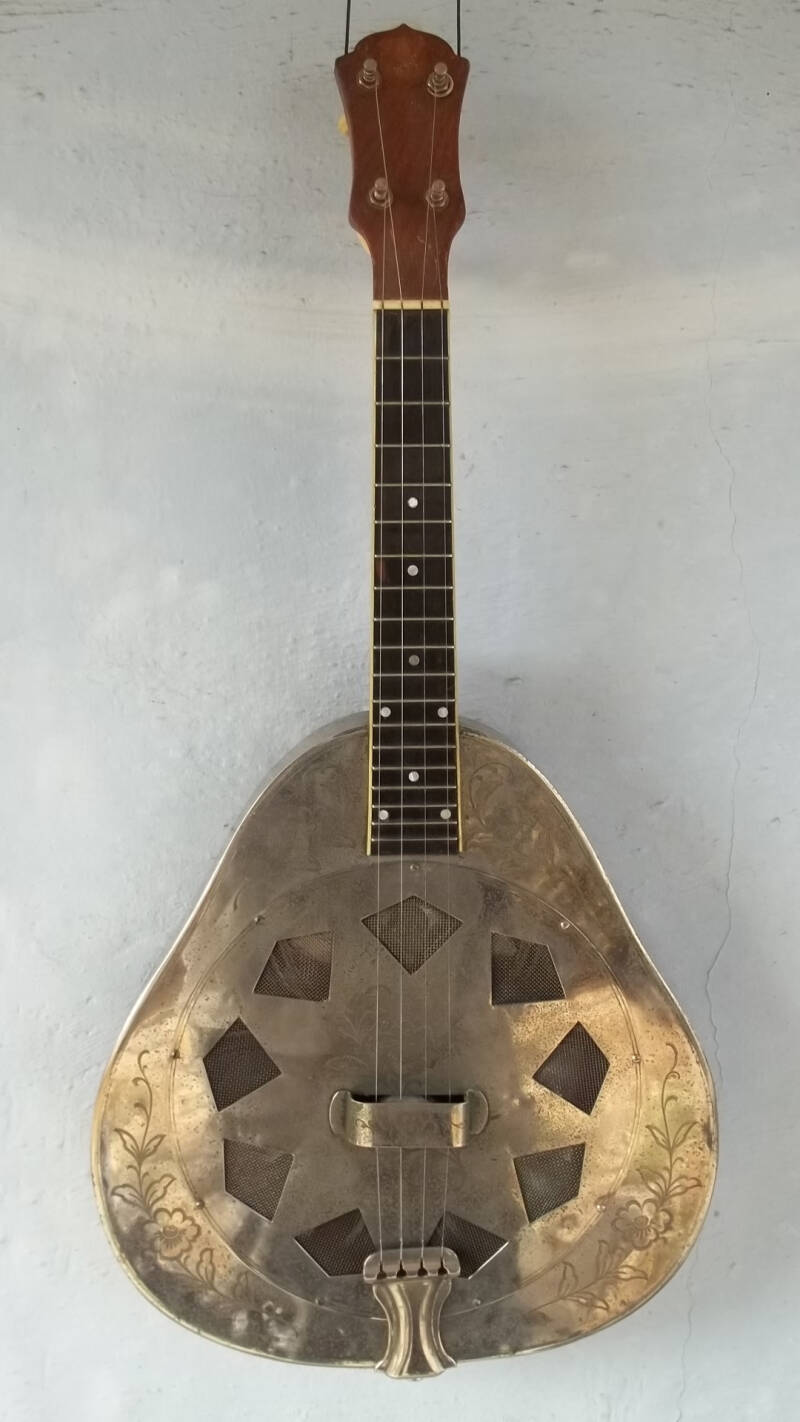
National Style 2 tricone ukulele #106 (photo Marc Schoenberger)
Tricone Ukuleles
Shortly after the invention of the tricone guitar, National applied the same three cone concept to tenor and plectrum guitars, mandolins and ukuleles. All of these have what we now call “pear shaped” bodies. The tenors and plectrums were somewhat successful (their amplifying system was identical to the 6 string guitars, including the triangular coverplate), but the tricone mandolin and ukulele weren’t - to say the least. Their bodies were smaller and fitting the cones in there through the round coverplate proved to be quite a challenge. The tricone and mandolins shared a serial number line (the body either got an 8 or 4 string neck) and only a little over fifty were built, of which currently six ukes are known. The mandolin continued with the same body shape but a single cone, the ukuleles were redesigned to the more classic uke shape, also single cone. Around 185 German Silver “large body” ukes (concert size) were built before National started building them with smaller bodies(soprano size).~
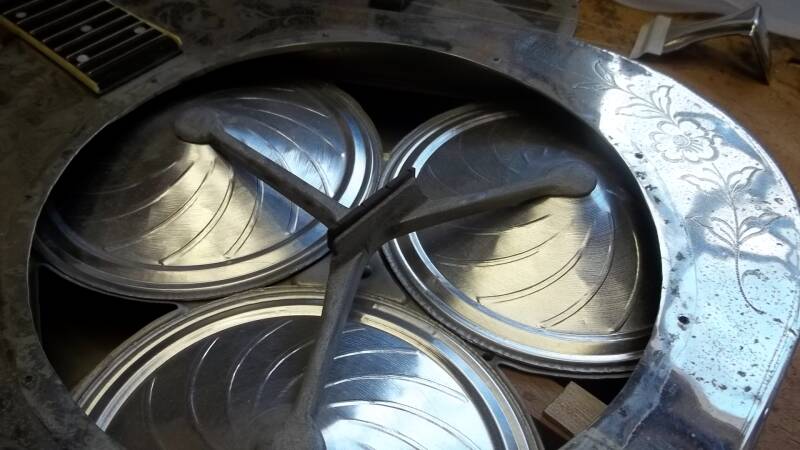
National Style 2 tricone ukulele #106, cone set-up (photo Marc Schoenberger)
Add comment
Comments